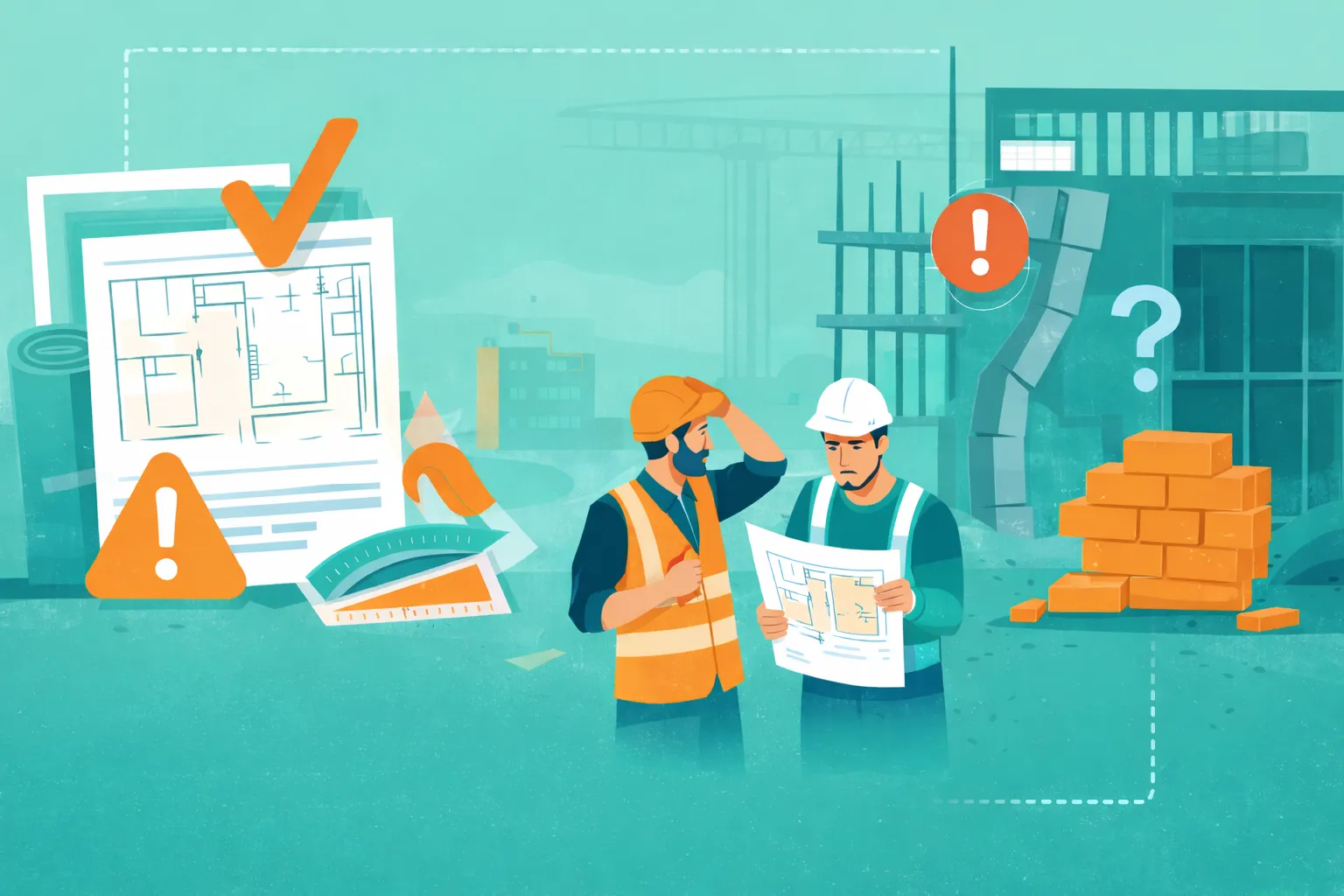
In construction projects, approved drawings are expected to eliminate ambiguity. Once reviewed, signed, and distributed, they are assumed to be safe for execution. Yet across infrastructure, residential, and commercial projects, construction drawing errors continue to surface even after formal approval.
This is not a rare exception. It is a structural disconnect between document approval and field execution at scale. The issue is rarely the absence of review. The challenge is whether approved revisions remain aligned with how thousands of moving activities unfold across site zones, subcontractors, and phases.
Understanding why this happens requires examining how construction drawing management, drawing version control, and construction document management software operate during real project workflows.
Approved construction drawings still cause costly site errors due to revision misalignment and weak coordination. Learn how to prevent rework with stronger version governance.
Why approval feels like the end of the problem
In most construction environments, drawing approval is treated as a milestone. It marks coordination closure between architects, structural engineers, MEP consultants, and client representatives. At that stage, teams shift focus from validation to execution.
However, approval only verifies the drawing content at a specific moment. It does not ensure that the approved revision remains the one being accessed, downloaded, or referenced across planning teams, procurement teams, and site engineers.
This creates a false sense of closure. Once approval is logged, risk is assumed to be reduced. But without structured drawing version control, the system depends on manual coordination to ensure alignment.
In complex projects where multiple revisions are issued, even a small delay in distribution or acknowledgment can result in outdated drawings being used on site. That is where construction drawing errors begin to occur despite formal approval.
Approval confirms review. It does not guarantee controlled execution.
Where drawing versions go out of sync
Version misalignment rarely happens at the approval stage. It happens during distribution, access, and field usage.
In many projects, revisions are shared through multiple communication channels. Even when a centralized system exists, drawings are often:
- Downloaded and stored locally
- Shared via email attachments
- Circulated in messaging platforms
- Printed and used in physical folders
Each of these actions creates independent copies. If field teams rely on local copies, construction drawing management becomes fragmented. The approved version in the system may no longer match the version used in execution.
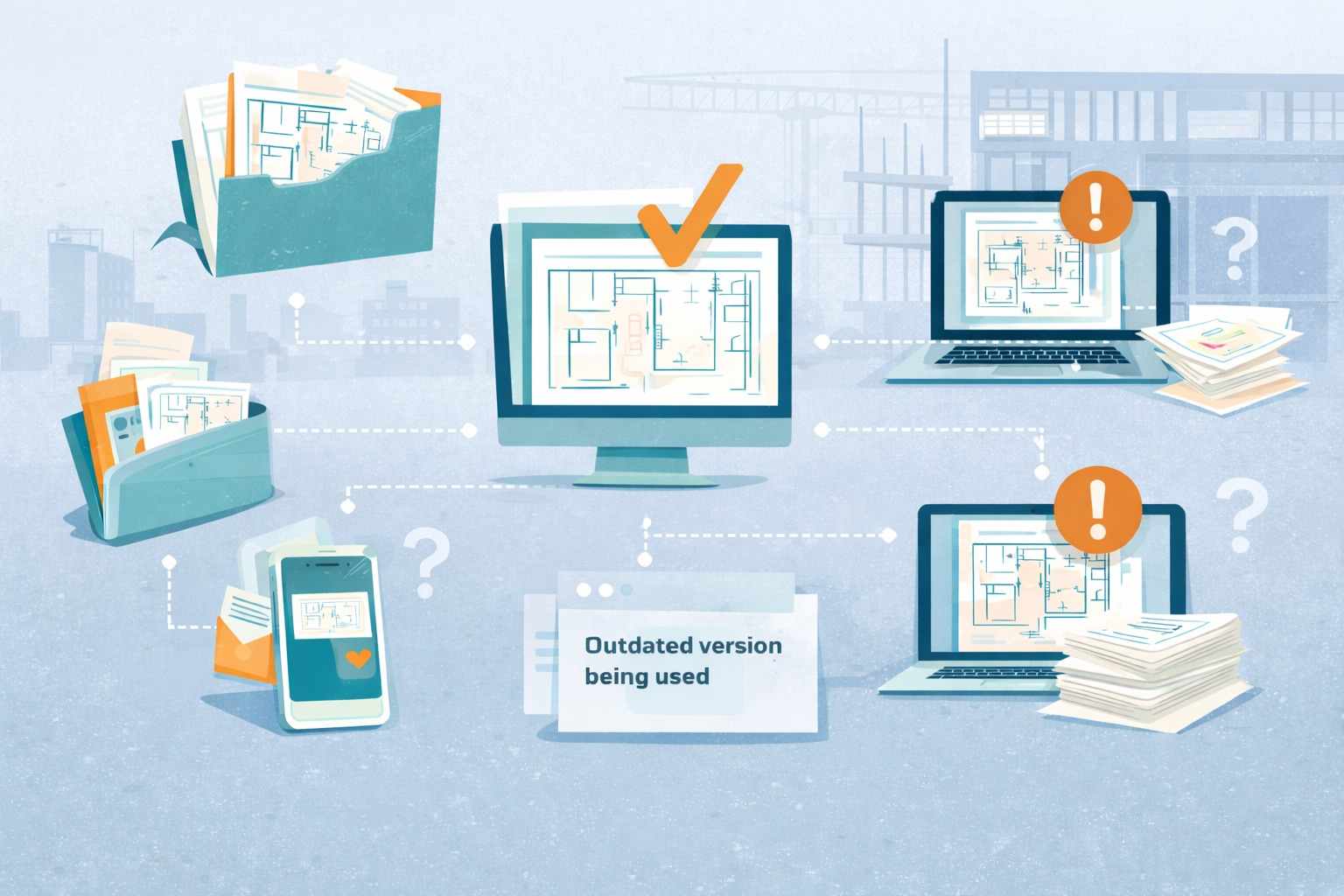
Without a single live source of truth inside construction document management software, teams may unknowingly refer to outdated revisions. This is especially common when:
- Design changes are issued rapidly
- Multiple consultants contribute updates
- Site teams operate under time pressure
- Acknowledgment tracking is informal
These small distribution gaps accumulate over time and directly contribute to recurring construction drawing errors.
How small version differences become major execution failures
A minor revision in a drawing can appear insignificant during review. It may involve a dimension change, a specification adjustment, or a layout correction.
- However, if site execution begins using a previous version:
- Downstream trades replicate incorrect references
- Structural components are positioned incorrectly
- Services are installed in misaligned locations
- Inspection teams identify discrepancies after installation
At this stage, correcting the issue requires physical rework. Labor hours increase. Material costs rise. Schedule pressure intensifies.
Because construction drawing management is often disconnected from real-time activity tracking, discrepancies are identified only after work has progressed. By the time the error surfaces, the cost impact is already embedded in the project.
Repeated construction drawing errors do not stem from poor design. They stem from uncontrolled version usage during execution.
Why review meetings detect issues too late
In many projects, drawing-related discrepancies are discovered during coordination meetings or inspection reviews. These reviews are typically retrospective.
By the time a mismatch is identified:
- Work has been executed
- Resources have been consumed
- Recovery planning becomes necessary
Without embedded drawing revision control, tracing which revision was used becomes an administrative investigation rather than an operational control.
Effective construction document management software should provide visibility before work begins, ensuring that the latest approved revision is the only version accessible for execution. When visibility is reactive instead of preventive, recovery replaces risk mitigation.
Why traditional document control systems fall short
Traditional document control processes focus on storage, approval routing, and archiving. These systems are designed to manage documents as files. They are not always designed to manage documents as active inputs into execution workflows.
Common limitations include:
- Drawings stored separately from activity schedules
- No direct linkage between a specific activity and its governing drawing revision
- No structured acknowledgment from field teams confirming version access
- No automated restriction on outdated revisions
This separation weakens construction drawing management. Approval workflows operate independently from execution workflows.
As a result, even when construction document management software records the correct revision, the field team may still reference an older version if controls are not integrated into site processes.
The gap is not about document availability. It is about document accountability during execution.
The core problem
Approved drawings exist within the system.
However:
- Execution tracking is separate from document tracking
- Multiple versions remain accessible
- Field usage is not centrally monitored
- Version acknowledgment is informal
This structural disconnect drives recurring construction drawing errors across complex projects.
The problem is not that drawings are unapproved. The problem is that approved drawings are not embedded into the workflow where decisions are executed.
The real issue
Errors do not occur because approval processes are weak.
They occur because approved drawings are not connected directly to site execution controls.
Without integrated drawing version control, document accuracy does not automatically translate into execution accuracy.
When drawing management systems operate independently from progress tracking systems, teams rely on coordination rather than structured control. Coordination works in small environments. It fails at scale.
That is the systemic reason why construction drawing errors persist even in well-governed projects.
The solution
Preventing drawing-related rework requires integrating document control directly into execution workflows.
Effective control involves:
- Linking drawings to specific activities and locations within the project
- Restricting access to outdated revisions automatically
- Maintaining a single live version accessible across all teams
- Tracking acknowledgment by site engineers and supervisors
- Making revision updates visible before work begins
When construction drawing management is embedded into execution tracking, approved drawings become operational controls rather than static files.
Inncircles integrated construction software integrates document workflows into execution systems. Instead of treating drawings as separate entities, they are connected to activities, work packages, and site progress. Revisions are visible in real time, and version access is structured across stakeholders.
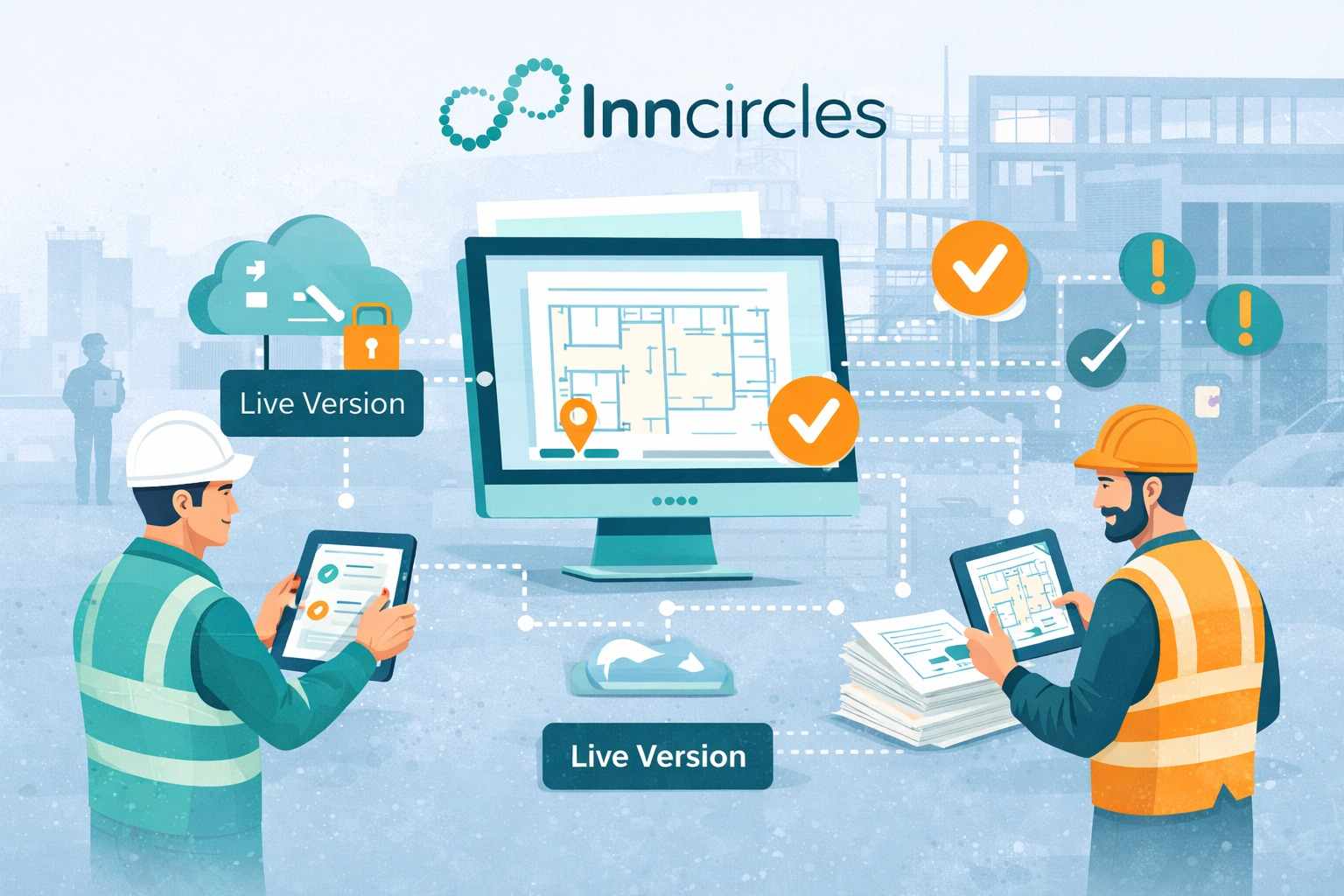
This alignment strengthens drawing version control and significantly reduces the likelihood of recurring construction drawing errors without slowing project velocity.
See how Inncircles’ valued customers achieved this
The final takeaway:
In construction projects, approval alone does not eliminate risk.
Execution alignment does.
Without connected construction document management software that embeds drawing version control into live workflows, projects remain vulnerable to version confusion and avoidable rework.
Reducing construction drawing errors requires shifting from isolated document approval to integrated execution visibility. When drawings are structurally connected to how work is performed on site, approvals translate into correct action rather than corrective action.
For organizations seeking stronger control across document workflows and site execution, Inncircles provides integrated construction management capabilities designed to prevent version misalignment before it impacts cost and schedule.