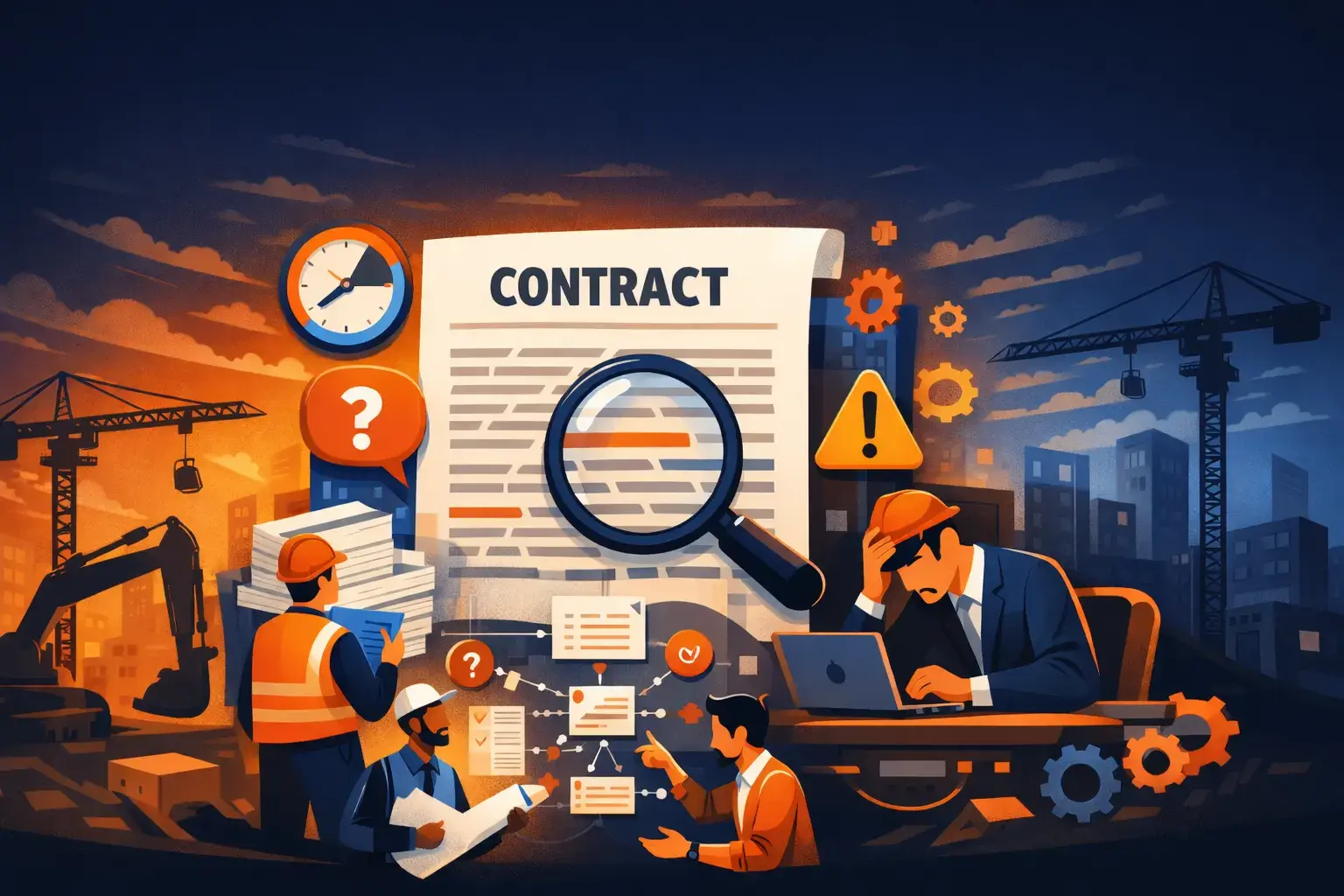
In construction, contract review is often treated as a routine step. Contracts are signed, stored, and referenced when questions arise. On smaller projects, this approach usually works. On large construction projects, it quietly becomes a source of delay and risk.
As project size increases, contracts grow in length and complexity. Multiple appendices, amendments, special conditions, and cross-references become common. The effort required for contract review increases, not just because there is more to read, but because finding the right information at the right time becomes harder.
The real cost of contract review is rarely visible upfront. It shows up later through slower decisions, coordination gaps, and rising uncertainty during execution.
Struggling with slow contract review on complex construction projects? Learn how teams reduce risk, speed decisions, and gain clarity using native agentic construction AI.
Why large construction projects change the contract review process
As construction programs grow, contract information rarely lives in one place. Core agreements, addenda, technical specifications, and clarifications are distributed across multiple files and systems.
Teams must connect these pieces while execution continues.
This reshapes the contract review process. Review stops being a one-time task and becomes an ongoing activity. Teams repeatedly search for clauses, confirm applicability, and check how conditions interact across documents.
At this point, manual contract review starts to feel strained. The approach depends heavily on time, attention, and individual knowledge, all of which are already under pressure on complex builds.
Why manual contract review becomes expensive at scale
The effort involved in manual contract review increases faster than expected as document volume grows. Reviewers often spend more time locating information than evaluating it.
Sections are revisited multiple times to confirm changes or validate obligations. Amendments require careful cross-checking. Clarifications may override earlier language. Each step slows the contract review process.
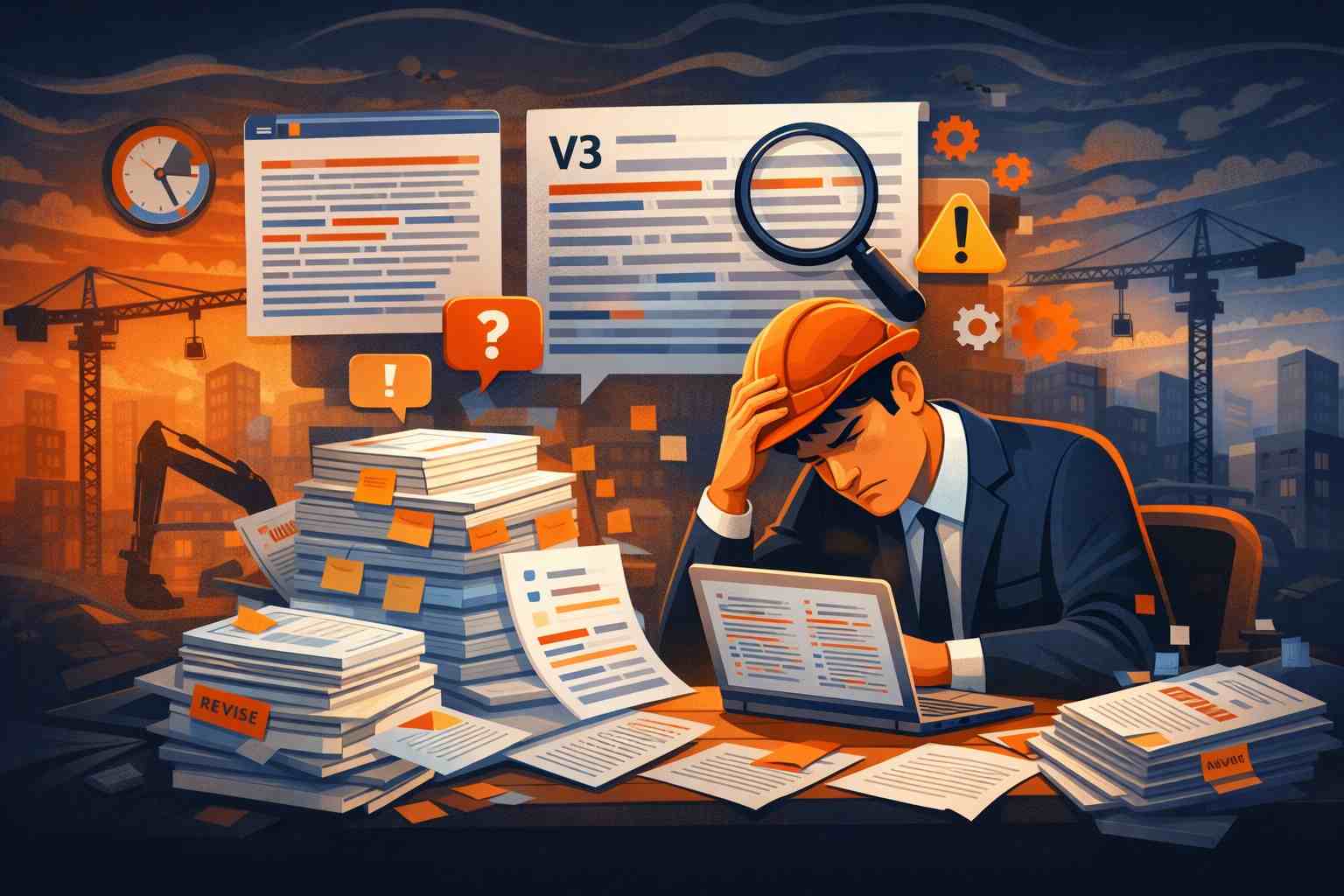
When clarity is delayed, decisions slow down. That delay creates room for construction contract risk to develop, not because teams lack discipline, but because they lack timely visibility.
How contract review delays affect the entire project
Slow contract review affects more than legal or commercial teams. Its impact spreads across daily project workflows.
Procurement may wait for confirmation before proceeding. Engineering teams pause when scope boundaries are unclear. Commercial approvals slow while exposure is assessed. Site teams escalate questions instead of acting.
These delays rarely show up as contract issues. They appear as coordination challenges or approval backlogs.
Over time, this pattern increases construction contract risk and adds friction to execution.
How manual contract review increases pressure over time
Reviewing long contracts manually requires sustained concentration. Teams read dense language, compare versions, and track changes across documents. As volume grows, fatigue becomes unavoidable.
Fatigue slows the contract review process and increases the chance of oversight. This is one of the less visible effects of manual contract review on large construction projects.
The process intended to reduce risk begins to add pressure when teams are overloaded. That pressure often surfaces later during execution, when questions arise, and answers are not easy to verify.
Repetition as a hidden cost in contract review
Construction contracts often reuse similar clauses across packages. Reviewers repeatedly examine familiar language to confirm nothing has changed.
This repetition consumes time without adding insight. The effort goes into validating what remains the same instead of focusing on what affects execution.
Over time, repetition becomes one of the biggest drains in the contract review process, especially when handled through manual contract review.
Why delayed clarity increases construction contract risk.
Most disputes and claims do not start with a single mistake. They develop through small gaps in understanding that persist over time.
When teams cannot quickly verify what the contract requires, they rely on discussions and assumptions to keep work moving. Those assumptions often differ across teams. On large construction projects, these differences can stay hidden until pressure increases.
This is how construction contract risk grows quietly. The issue is not missing contracts. It is delayed clarity during contract review.
How construction AI for contract review supports modern workflows
This is where construction AI for contract review becomes relevant.
Instead of relying only on manual searching, construction AI for contract review helps teams work with contract content in a structured way. It reduces the effort required to locate clauses, compare versions, and verify obligations within the contract review process.
By shortening the time between question and answer, construction AI for contract review helps decisions move faster across procurement, engineering, and commercial workflows. This directly reduces construction contract risk on large construction projects.
Where Bob enters the game of construction AI
Bob Construction AI supports construction workflows by helping teams work with information inside contracts and related project documents.
In the context of contract review, the Contract Analysis Agent helps surface relevant obligations, risks, and responsibilities while keeping links back to the original clauses.
This reduces reliance on manual contract review and strengthens the contract review process, especially on projects with high document volume and frequent changes. Teams spend less time searching and more time validating and deciding.
This shift becomes critical in large projects. The same review methods that work on smaller jobs often break down as complexity increases.
On your table:
The hidden cost of contract review is not limited to reading time. It includes delayed decisions, repeated searching, and growing uncertainty during execution.
In the case of large construction projects, relying entirely on manual contract review makes the contract review process difficult to sustain. That strain often appears later as increased construction contract risk and slower project progress.
If your teams are spending more time chasing contract clarity as projects scale, it may be time to rethink how contract review is handled.
Bob helps construction teams bring clarity forward so decisions are made with confidence and execution stays aligned.
Book a demo to see how Bob supports contract review on large construction projects.