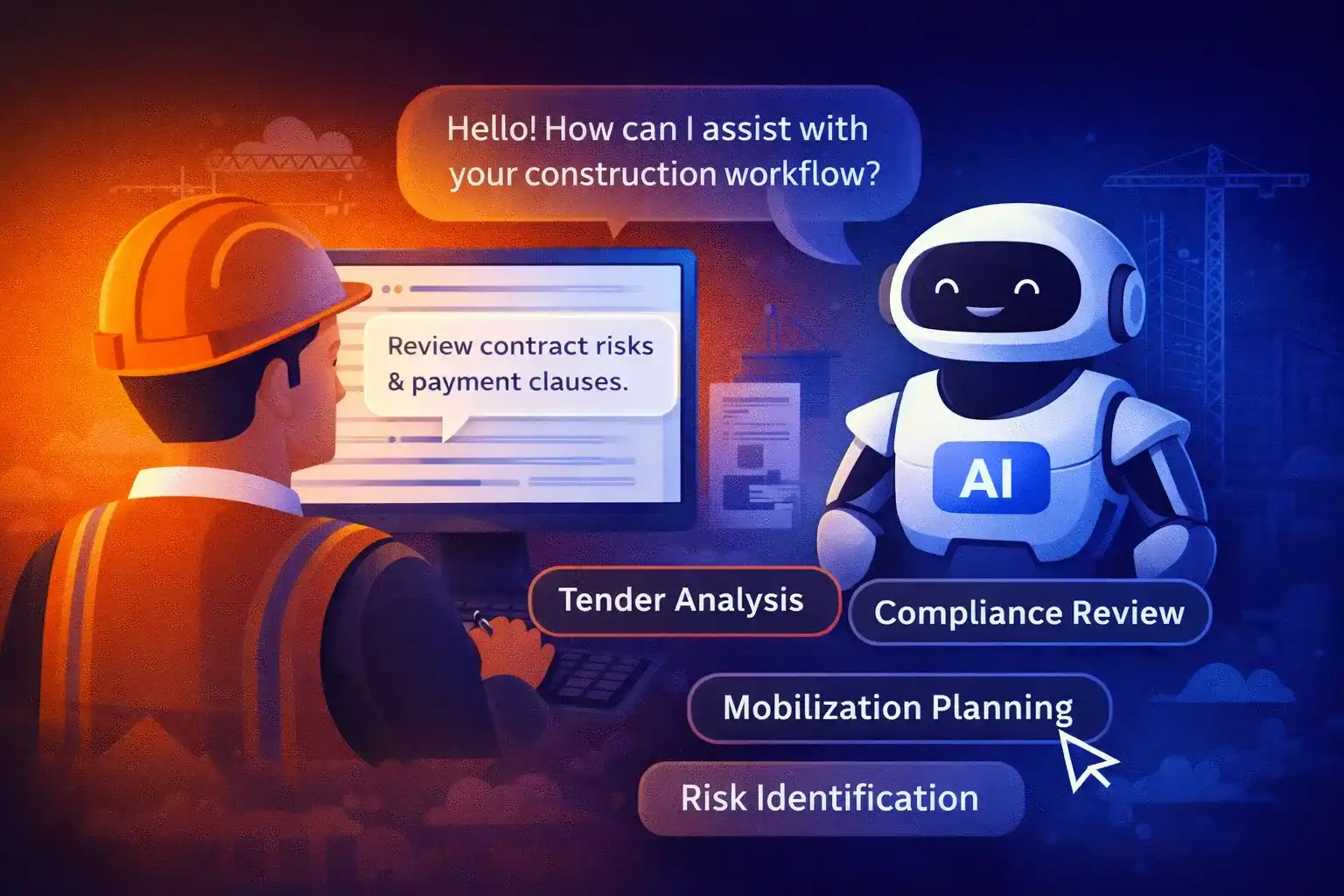
Construction teams are increasingly turning to construction AI to support contracts, specifications, proposals, and tender documents. The interest is clear. The results, however, often fall short of expectations.
Many professionals try AI, receive outputs that feel broad or incomplete, and quickly lose confidence. The technology seems capable, yet something feels missing.
The challenge is not that construction AI cannot handle construction information. The challenge is that construction work is highly specific, while most AI interactions remain too general.
When someone asks AI to “summarize this contract,” it delivers a summary. What it does not know is which clauses affect execution, which obligations create risk, or which terms will impact the project months later. In construction, those details are critical.
This disconnect between how construction professionals think and how they interact with construction AI is where accuracy begins to break down.
Explore how construction AI delivers better accuracy when clear prompts improve document reviews, contract analysis, and everyday project decisions.
Why construction teams struggle to get accurate results from construction AI
Construction documentation is built on precision. Contracts define responsibility. Specifications define performance. Drawings define execution. Qualification documents determine eligibility.
Even small ambiguity can turn into delays, disputes, or rework long after work has started.
When prompts are unclear, construction AI responds like a general assistant. It explains instead of evaluating. It summarizes instead of flagging issues. Teams are then forced to manually verify outputs during construction document review, which reduces trust in the tool.
What teams actually need is not more advanced technology, but clearer instructions that reflect how construction professionals already analyze documents.
How vague instructions limit the value of construction AI
Consider a typical contract review.
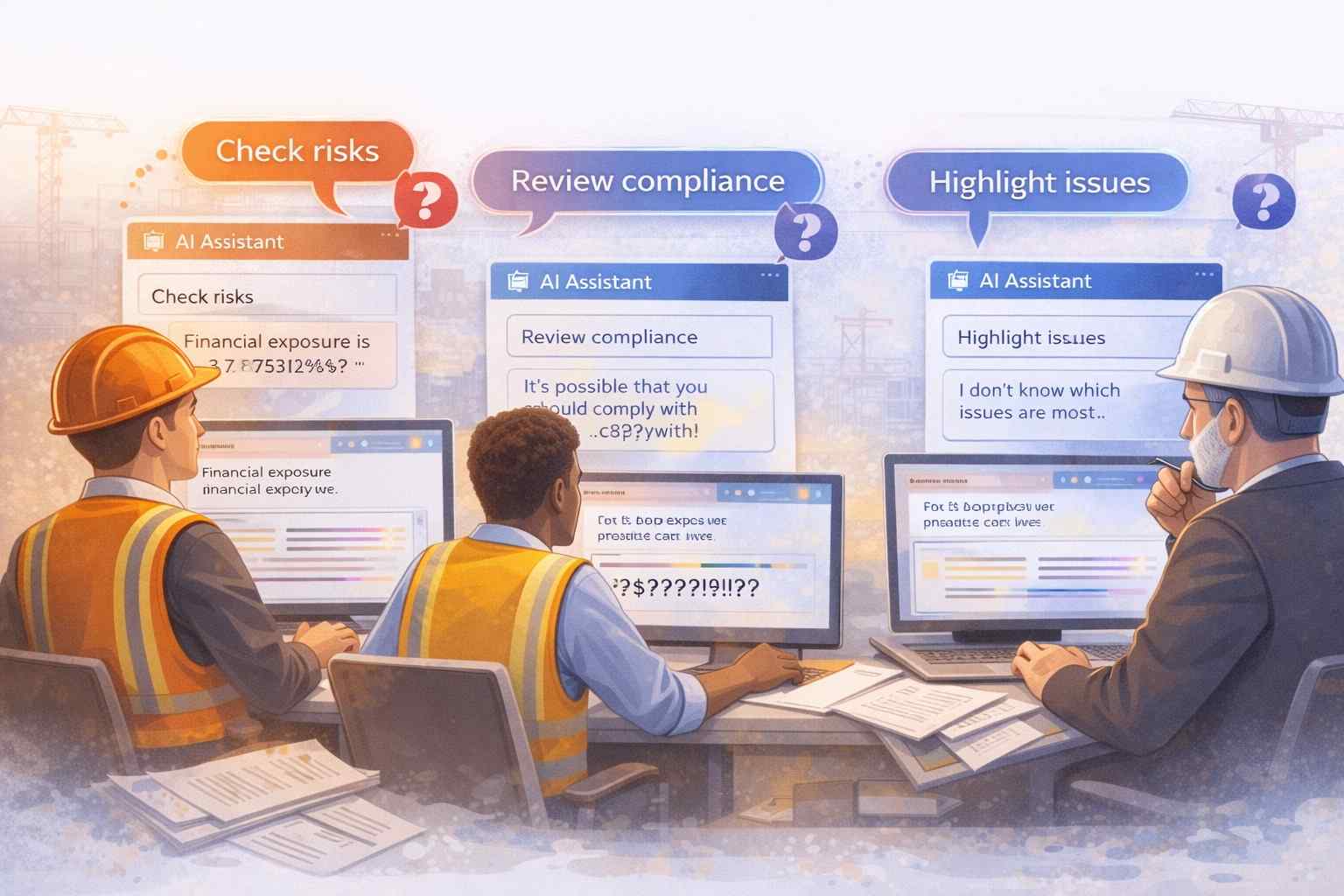
One reviewer asks AI to “check risks.” Another asks it to “review compliance.” Someone else asks it to “highlight issues.” Each prompt produces a different response. None of them fully aligns with the team’s decision-making needs.
The result is familiar. Reviewers still reread clauses, cross-check references, and debate interpretations. Construction AI becomes an extra step rather than a time saver.
Construction problems are structured by nature. When prompts lack structure, accuracy suffers. This is where thoughtful prompt engineering makes a real difference.
Better prompting for construction AI improves accuracy and relevance
When construction teams prompt AI with clear intent, the quality of results improves immediately.
- Effective prompts identify the document type.
- They specify the discipline involved.
- They clarify the decision the team needs to make.
For example, asking for “payment terms that impact cash flow during execution” delivers far more useful insight than requesting a general summary. The AI understands what matters and why.
This is when construction AI begins supporting practical workflows such as tender analysis and focused construction document review, rather than producing surface-level outputs.
Why structured prompts lead to defensible decisions
Construction decisions must be defensible to management, clients, auditors, and sometimes legal teams.
When construction AI is prompted to reference specific clauses, separate facts from interpretation, or compare obligations across sections, the output becomes easier to review and trust. Teams can clearly see what has changed, what is missing, and where potential risk exists.
This level of clarity is especially valuable during compliance review and risk identification, where accuracy matters more than speed.
Treating construction AI like a junior engineer works better
Teams that see consistent results from construction AI do not treat it like a search engine.
They treat it like a junior engineer who needs direction.
- They ask one focused question at a time.
- They refine prompts based on responses.
- They guide the analysis step by step.
This mirrors how real construction reviews are conducted: methodical, intentional, and structured. This practical approach is the foundation of effective prompt engineering in construction.
Better prompting strengthens expertise; it does not replace it
Construction AI does not replace engineering judgment. It reduces the manual effort that slows it down.
When structured prompting is combined with a system built for construction workflows, accuracy becomes repeatable.
This is where Bob, the central construction-trained AI agent, strengthens structured construction AI usage.
Instead of generic prompts, teams can:
- Compare multiple contracts instantly
- Define custom risk parameters aligned with their organization
- Request clause-level reasoning with direct references
- Separate factual obligations from interpretation
- Link related documents during review
During construction document review, Bob does more than summarize. It highlights deviations, identifies missing clauses, and maps risk to defined parameters.
During tender analysis, it extracts eligibility gaps, payment triggers, and contractual obligations that affect execution.
For structured compliance review, teams can define what compliance means internally and evaluate documents against that framework.
For proactive risk identification, teams can detect financial, legal, and operational exposure before execution begins.
This approach embeds prompt engineering in construction directly into workflows, not as an experiment but as an operational discipline.
Expertise remains central. Manual burden reduces. Decision clarity improves.
Ready to enhance your construction workflows?
If you want construction AI that actually understands contracts, specifications, and project documents, Bob helps teams review faster, spot risks earlier, and work with confidence, without changing how they already think or work.