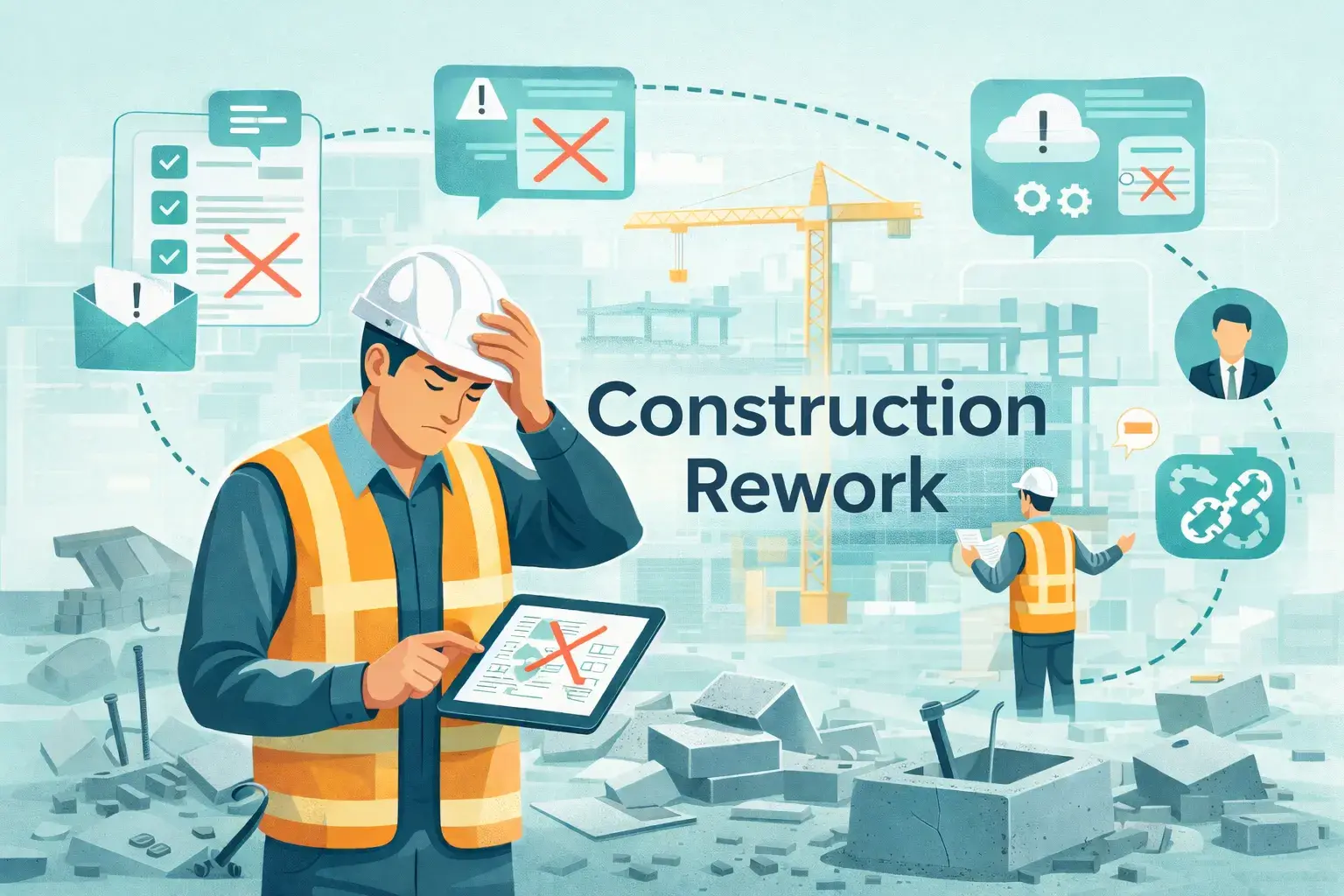
In construction projects, rework never announces itself early.
Let’s take a real-world instance where a construction project feels stable. Activities are progressing. Teams are aligned. Next, walls are being chipped, finishes are removed, and completed work is undone. Meetings multiply. Schedules shift. Costs quietly rise.
And the same question echoes across the site: how did this happen?
Here is the reality many teams miss. Construction rework rarely begins where the problem becomes visible. It starts much earlier, long before corrective work appears on site.
It begins when a quality check is rushed. When an inspection feels routine. When pausing work seems riskier than moving forward. At that moment, nothing looks wrong. Progress feels intact. The risk feels manageable.
See how disconnected quality processes lead to construction rework and how construction teams can prevent costly fixes with connected workflows.
Why are early quality issues easy to miss in construction rework?
Early quality issues are rarely obvious. That is exactly why they are dangerous.
Most projects perform inspections, but those checks are often treated as compliance requirements instead of control points. The focus shifts to completing the checklist rather than validating whether work is truly ready to move forward.
Schedule pressure makes this worse. Delays are visible and immediate. Quality risks are subtle and delayed. When timelines tighten, caution is often the first thing compromised.
Many defects also do not surface right away. Alignment issues, specification mismatches, or incomplete finishes may look acceptable until downstream trades begin work.
This is where construction quality control quietly weakens. The issue is not the absence of inspections. It is that quality signals are not strong enough to influence execution decisions.
Missed quality signals do not fade over time. They compound until rework becomes unavoidable.
The disconnect between quality and execution behind construction rework
A major contributor to construction rework is the gap between inspections and daily site execution.
Quality observations are often recorded in separate logs or reports. Execution teams continue working from drawings and schedules that do not reflect unresolved issues. Work moves forward under the assumption that everything has been cleared.
When inspections are not linked to specific activities or drawings, there is no natural pause in execution. Closure depends on manual follow-ups rather than built-in process controls.
This breaks the feedback loop between QA teams and site teams. Issues exist, but they do not guide action when it matters most.
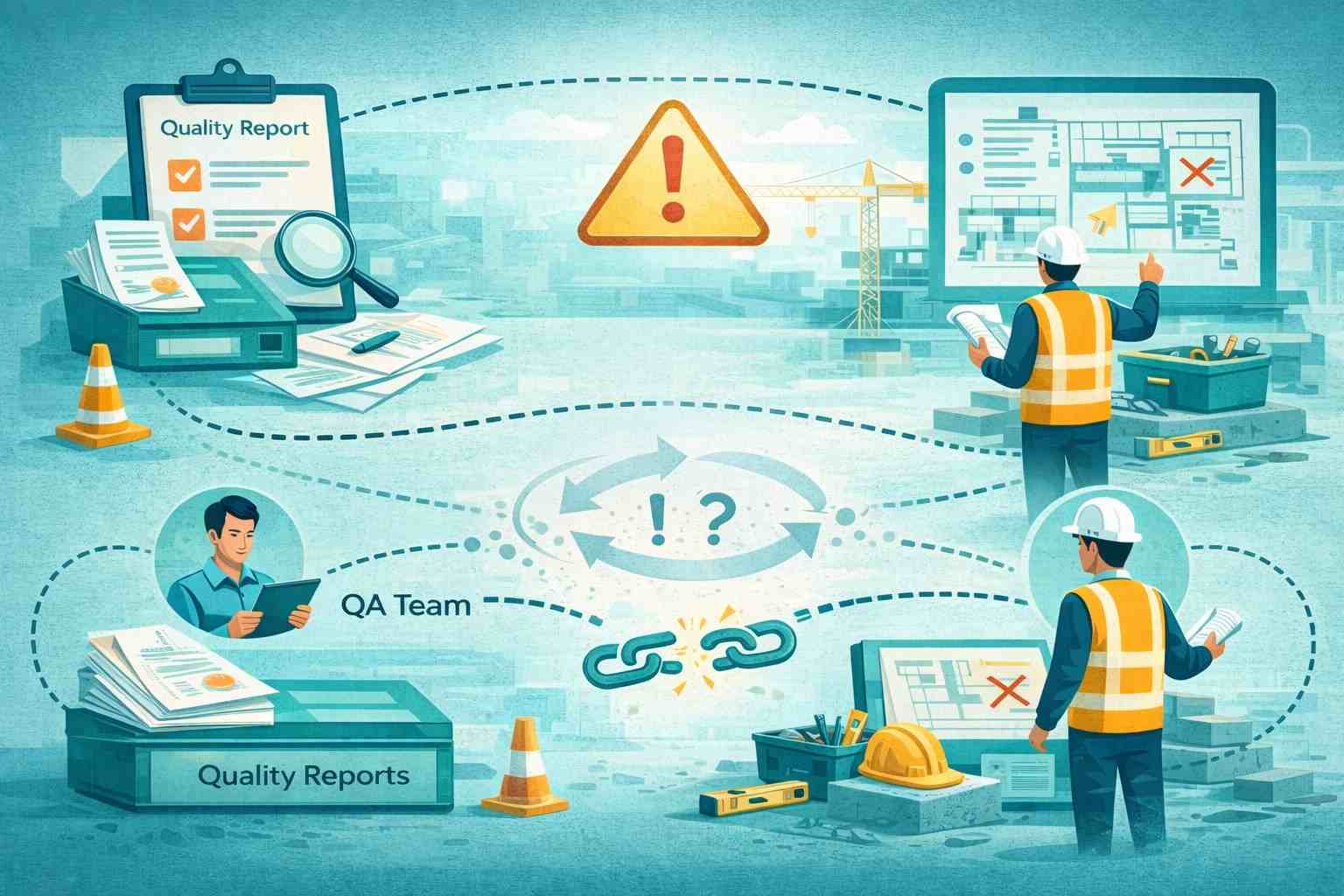
From a construction process management standpoint, this disconnect creates blind spots. Quality becomes documentation instead of direction.
How small gaps escalate into major construction rework
Rework rarely starts as a major failure.
A single unresolved issue feels manageable. But once covered by subsequent work, access becomes restricted. Fixing it now requires undoing completed activities.
What could have been corrected early begins to affect multiple tasks. Dependencies shift. Sequencing breaks. The impact spreads beyond the original scope.
At this stage, construction rework no longer affects just one activity. Schedules absorb disruption. Costs rise. Tracing the original cause becomes difficult as time passes.
Without connected construction workflow software, teams respond after the damage is visible instead of preventing it earlier.
Why is construction rework so expensive?
Rework does not just add cost. It drains momentum.
Labor is repeated. Materials are reordered. Equipment is rescheduled. Planned productivity gives way to recovery work.
Sequencing disruptions ripple across trades, increasing idle time and coordination effort. Teams shift from building forward to fixing backward.
Trust also takes a hit. When issues surface late, accountability becomes unclear, and friction replaces flow.
From a construction process management perspective, rework is one of the most damaging cost drivers because it is unplanned. It quietly consumes buffers until there is nothing left to absorb.
This is why quality management in construction must focus on prevention, not correction.
Check out here to understand the causes of construction rework in detail and the ways to reduce them.
Why traditional quality reporting falls short
Traditional quality reporting was designed to record information, not control execution.
Paper checklists and isolated inspection logs delay visibility. Issues remain unresolved without clear ownership. Closure depends on reminders, emails, or meetings.
There is limited traceability between a defect and its downstream impact. When construction rework occurs, teams know something failed but struggle to identify where the process broke.
Traditional construction quality control captures problems after they happen. It does not influence what happens next on site.
Click here to explore more ways to improve construction quality management in your projects.
The problem
Quality inspections often operate in isolation.
Issues are recorded but not connected to execution. Closure relies on manual follow-ups. Early warning signs exist, but they are easy to overlook.
This is not a site issue. It is a process design issue.
The real issue
Rework does not come from poor execution alone.
It comes from disconnected quality controls.
The solution
Preventing construction rework requires quality processes embedded into daily execution.
Teams need to link quality checks directly to activities and drawings. That keeps inspections connected to what is being built, not stored separately as standalone notes.
Downstream work should not proceed until issues are resolved. When closure is confirmed before the next trade moves forward, defects are stopped before they get covered or compounded.
Ownership for closure must be clear. When someone is responsible for closing an issue, follow-up becomes part of the workflow instead of a manual chase.
Quality signals need to be visible to all stakeholders in real time. When everyone sees the same status, teams stay aligned, and execution decisions are based on verified readiness.
Inncircles enables this by integrating quality inspections with execution workflows so defects are caught early, accountability is clear, and construction rework is prevented rather than corrected.
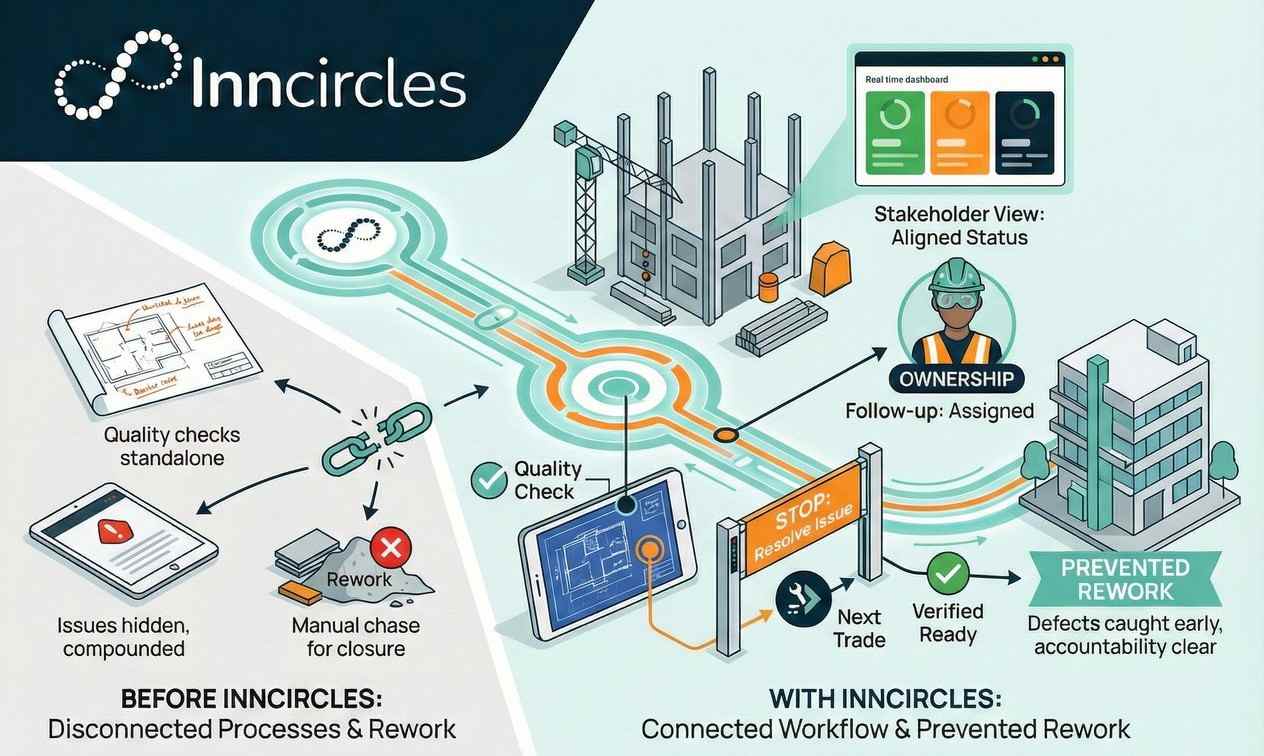
This is where connected construction workflow software makes a difference.
Inncircles construction software integrates quality inspections with execution workflows so defects surface early, accountability is built into the process, and rework is prevented instead of corrected.
Quality stops being a report. It becomes a control.
What to do next
Rework is rarely a surprise when teams look back.
The signals were there. An inspection is left open. An observation not tied to execution. A quality check that lived in a report instead of the workflow.
Avoiding construction rework is not about adding more inspections or slowing teams down. It is about connecting construction quality control directly to daily execution, so risks are addressed before work moves forward.
By strengthening quality management in construction, Inncircles ensures inspections are linked to activities and drawings, unresolved issues are visible in real time, and closure is enforced before downstream work continues.
With clearer ownership and connected workflows, teams stop reacting to rework and start preventing it. Execution stays aligned. Schedules stay intact. Costs stay under control.
If rework keeps appearing late on your projects, the issue may not be effort. It may be how quality fits into execution. Book a demo with Inncircles to know how your construction teams turn quality into a connected, real-time process that protects time, cost, and confidence.