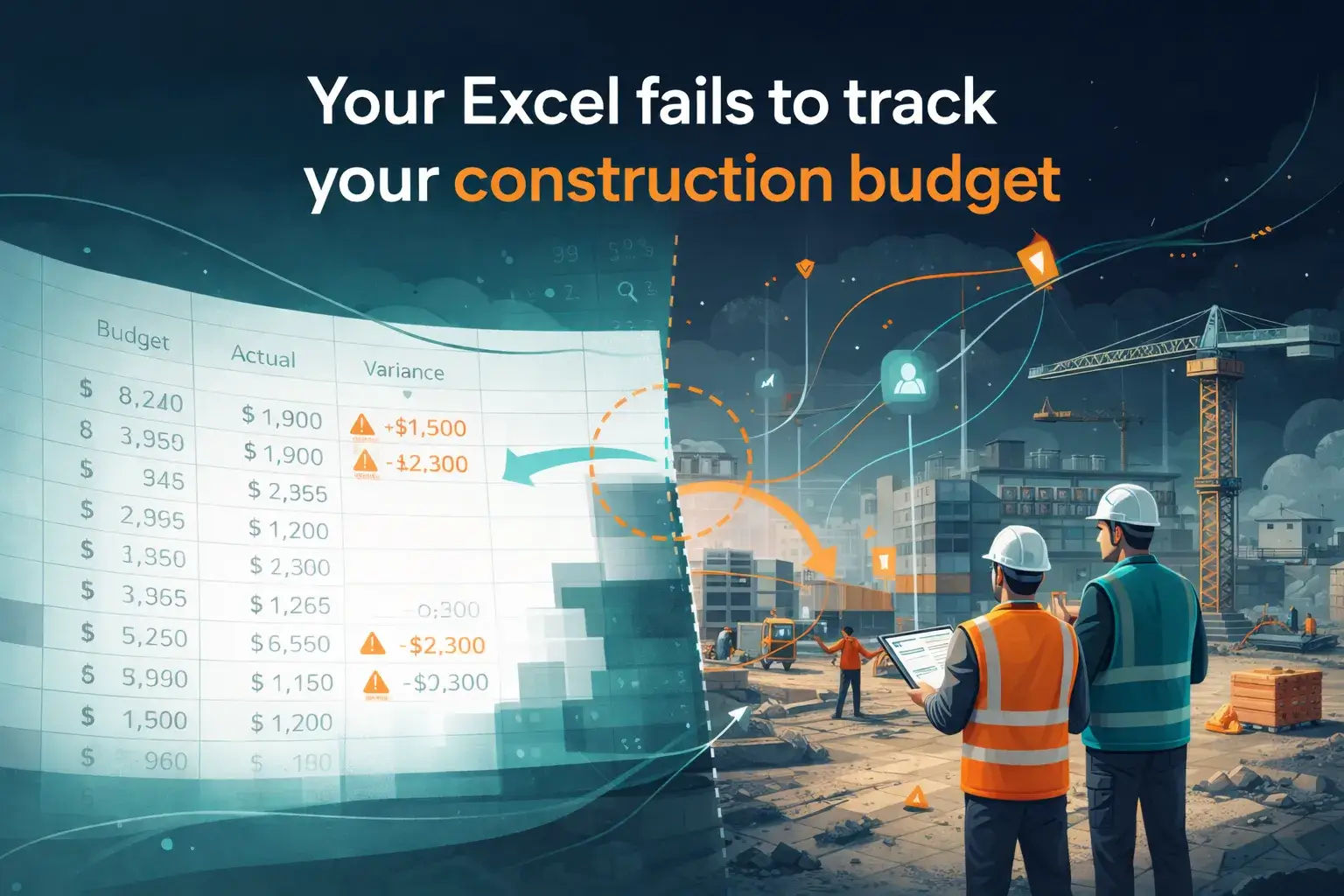
On most construction projects, Excel is where budget tracking begins.
BOQs are loaded. Cost heads are created. Initial estimates are broken down by trade and package. For a while, everything lines up. Site engineers send updates, quantity changes are adjusted, and cost reviews feel under control.
Then execution picks up speed.
Multiple contractors mobilize. Work fronts open in parallel. Site decisions start affecting material consumption, productivity, and costs on a daily basis. The spreadsheet still exists, but it no longer reflects what is really happening on site.
At that point, budget tracking is no longer about organizing numbers. It is about keeping pace with live construction execution. That is where Excel starts falling behind.
Explore why Excel fails at budget tracking in construction and how real-time cost tracking construction software improves cost control at scale.
Why Excel feels like the right tool for budget tracking at first
Excel fits naturally into early construction workflows.
It is familiar to project teams, quantity surveyors, and commercial managers. There is no setup time and no disruption to existing processes. For early-stage budget tracking, where scope is relatively stable and decisions are limited, spreadsheets work well enough.
During this phase, budget vs actual tracking happens at defined intervals. Updates come from a small group. Cost movement is slow. Reviews are manageable.
This early comfort creates confidence. And that confidence often leads teams to keep using Excel even as the project moves into full-scale execution.
What changes when projects scale
Once construction moves into active execution, the nature of cost control changes.
Work packages run simultaneously across trades. Contractors submit running bills in parallel. Quantities change as drawings get revised and site conditions evolve. Decisions taken by site teams immediately affect cost outcomes.
At this stage, waiting for periodic updates is no longer effective. Real-time cost tracking becomes essential because cost impact is being created continuously, not monthly.
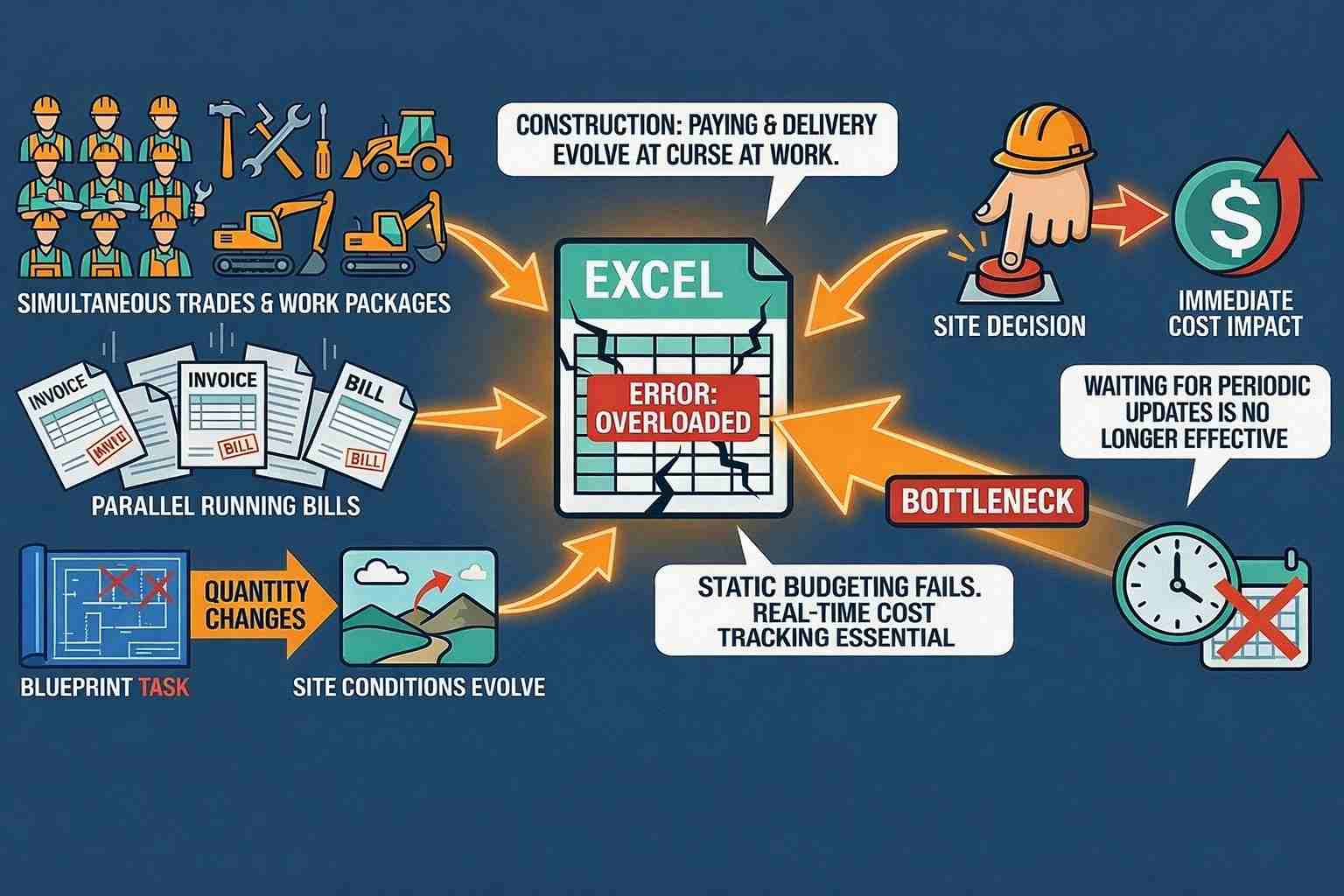
This is also where budget tracking shifts from a commercial exercise to an execution-driven one. The budget is no longer static. It is influenced daily by how work is progressing on site.
Where Excel starts to break
Excel struggles when information flow increases.
Cost data now comes from multiple sources: site reports, contractor submissions, consumption records, and progress updates. Someone has to manually collect this data, validate it, and update the sheet. Every step adds delay.
Over time, versions multiply. Teams reconcile files instead of reviewing performance. Budget tracking starts lagging behind execution.
Most importantly, Excel has no native link to site activity. It cannot connect execution events to cost automatically. This is the core reason construction cost control software becomes necessary as projects scale.
Why real-time cost signals get lost
In construction, cost signals originate on-site.
Material usage exceeding planned quantities. Productivity is slowing down in a work zone. Rework caused by design changes. These signals appear first in execution, not in spreadsheets.
Without real-time cost tracking, these signals reach the budget late. By the time budget vs actual tracking reflects the deviation, the cost impact is already locked in.
This is where construction data analytics plays a role. Not as a report at the end of the month, but as a way to surface early deviations while corrective action is still possible.
The risk of managing scale with static tools
Static tools create delayed visibility.
Forecasts depend on assumptions rather than live execution inputs. Cost reviews become backward-looking. Overruns are identified after they have already materialized.
As confidence in budget tracking declines, teams start maintaining parallel reports. Alignment slows. Decision-making becomes reactive.
At this stage, the issue is not effort or discipline. It is that static tools cannot support dynamic construction execution.
The problem
Excel ends up being used as the primary system for budget tracking.
Execution data lives outside the spreadsheet. Updates rely on manual consolidation. Budget vs actual tracking happens after the fact.
In this setup, real-time cost tracking is structurally impossible, regardless of how well the sheet is maintained.
The real issue
Excel does not fail because it lacks capability.
It fails because scale demands live execution data.
The solution
Scalable budget tracking requires systems built around execution workflows.
At scale, construction teams need connected business workflows where site activity directly feeds cost updates. They need budget vs actual tracking that stays current as work progresses. They need construction data analytics that highlights trends early, not after overruns occur.
This is where construction cost control software changes how cost management works. Instead of chasing updates, teams gain continuous visibility. Instead of reconciling files, they work from one live source of truth.
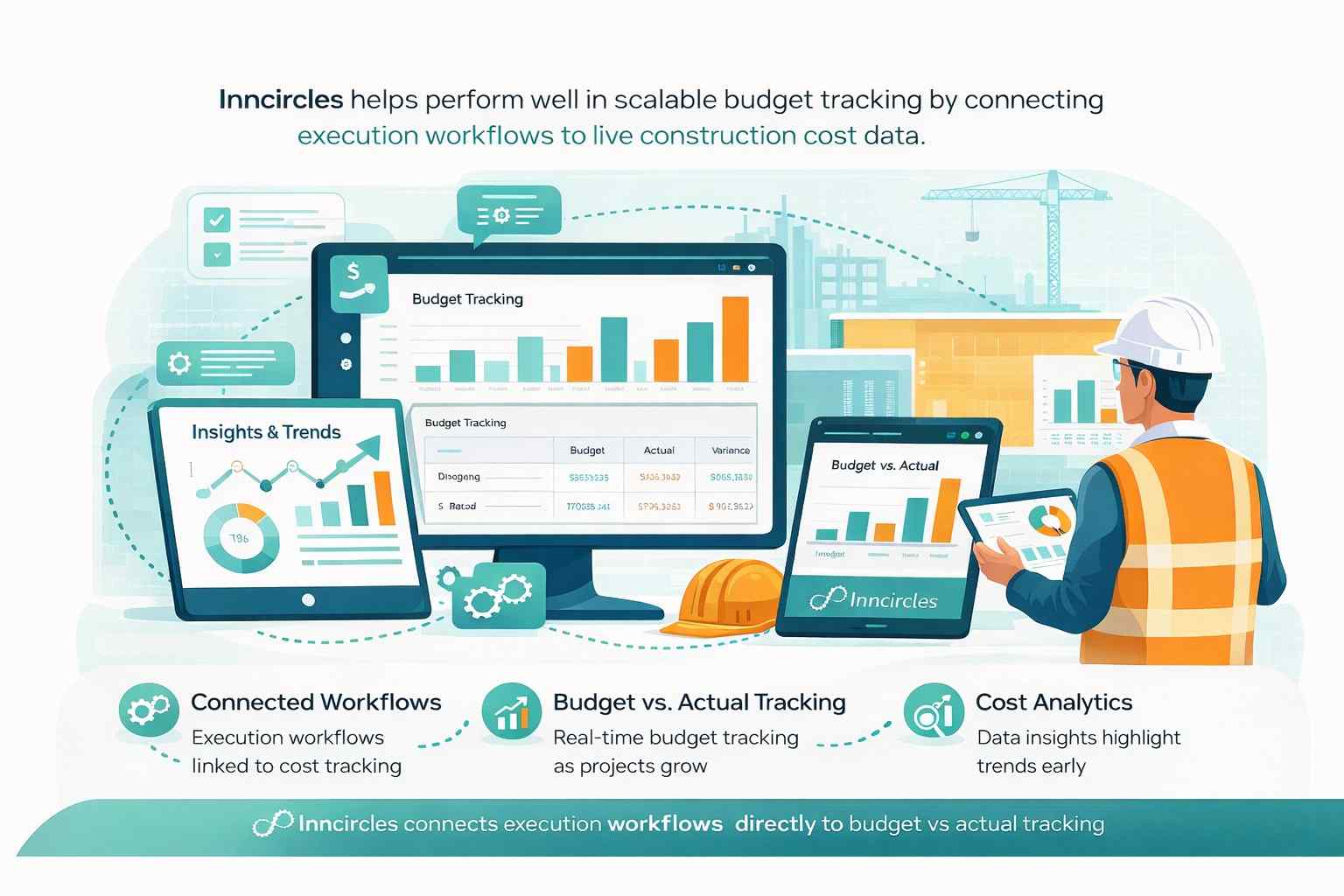
Inncircles connects execution workflows directly to budget tracking, ensuring cost visibility improves as projects grow.
By linking connected business workflows with budget vs actual tracking and construction data analytics, inncircles enables real-time cost tracking without increasing manual effort.
As execution scales, control strengthens instead of breaking down.
To sum up:
Spreadsheets are useful for organizing data. They are not designed to manage live construction execution.
As projects grow, budget tracking must move from static reporting to connected, real-time insight. That shift often determines whether cost overruns are controlled early or discovered too late.
Inncircles helps construction teams make that shift with connected workflows, real-time cost tracking, and reliable budget vs actual tracking, all built for execution at scale.