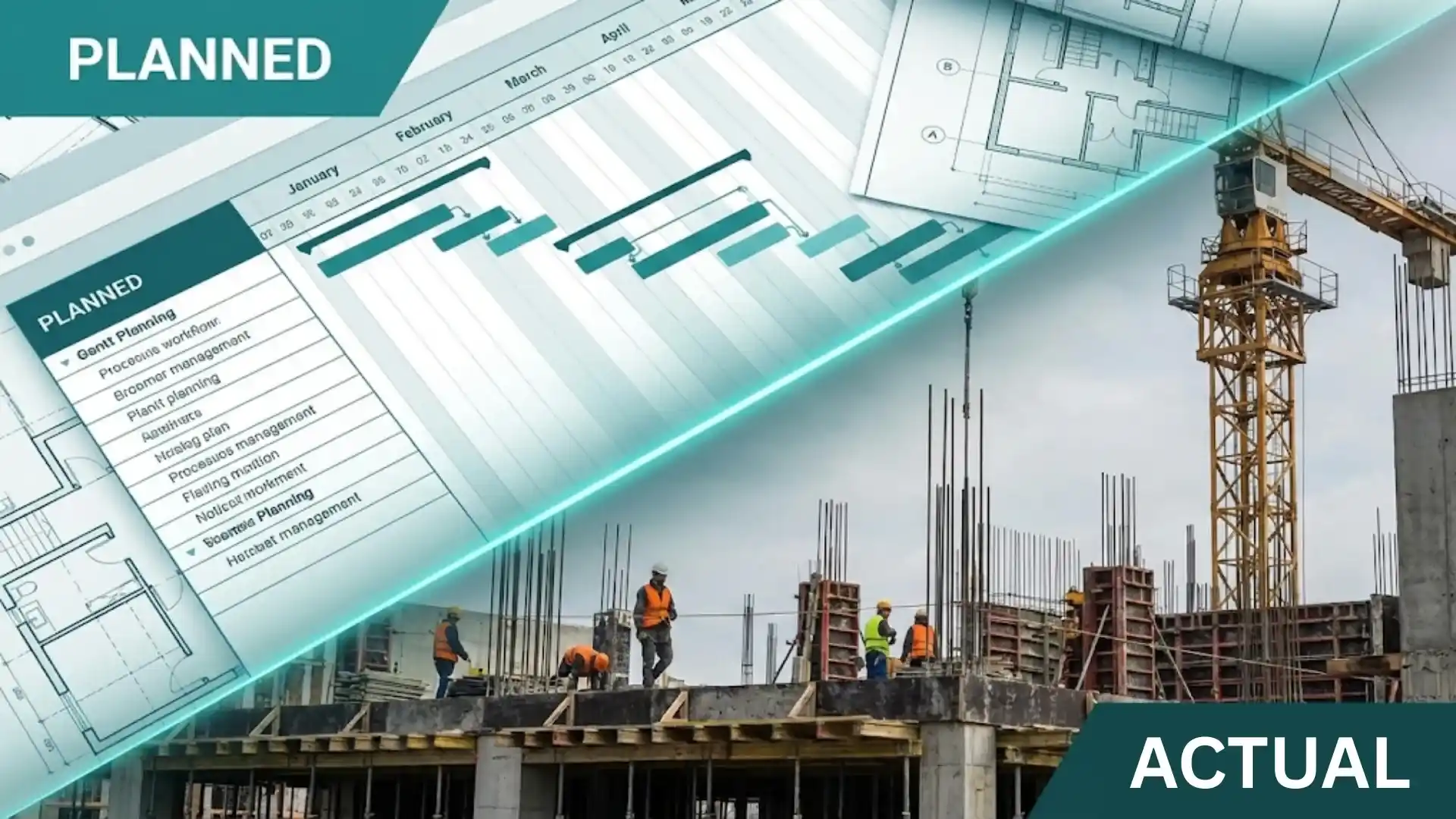
Nothing hides project risk more effectively than the widening gap between planned vs actual in construction.
In construction projects, teams encounter a conflicting reality where the paperwork contradicts the job site:
- The schedule says the activity is complete.
- The report shows 100 percent.
- The milestone has been achieved.
Yet, on-site, the work is still in progress.
This is usually how derailment begins. Not with a big failure, but with a small mismatch between what the timeline says and what the site is actually delivering.
If that sounds familiar, you are not alone. This gap between what is planned, what is reported, and what is actually happening is one of the most common and most dangerous blind spots in construction. Projects don’t derail because teams stop planning or reporting. They go off track because the difference between the timeline and execution is detected too late.
In construction, accuracy matters more than activity. Without reliable tracking of execution against the schedule, timelines become optimistic narratives rather than decision-making tools. And when leadership loses trust in the numbers, control starts to slip.
Learn why accurate planned vs actual in construction matters more than weekly reporting for early risk detection and reliable forecasting.
Why planned vs actual in construction is the backbone of project control
Planning sets intent. It defines sequence, dependencies, and deadlines. Actual execution reveals reality, what truly moved on site, what stalled, and what quietly slipped.
The engine of construction project controls is not the plan alone. It is the continuous comparison between intent and execution. That comparison is what allows teams to intervene early, when recovery is still manageable.
When tracking accuracy is high and execution data is updated continuously, teams can spot deviation early, reassign crews, resequence activities, or protect the critical path before damage compounds.
When it is not, schedules turn ceremonial. They exist, they are reviewed, but they no longer influence outcomes.
A PWC publication states 98% of construction projects experience delays or overruns, largely because timeline drift is detected after commitments have already been missed.
In short, construction project controls work when execution tracking functions as a live control loop, not a retrospective document.
Reporting does not equal accuracy.
This is where most projects fall into the trap.
Teams report frequently. Dashboards are updated. Meetings happen weekly. But frequent reporting does not mean the data reflects site reality.
Manual updates introduce lag and bias. Percent completion is interpreted differently by each team. One updates based on effort spent, another on partial output, and another on what they expect to finish soon.
This creates a dangerous illusion. Construction progress tracking appears active, but accuracy is missing. Leadership sees movement, but cannot rely on it. The report suggests progress, while the site struggles quietly.
Reporting only helps when it reflects reality. Without accuracy in execution tracking, reports create confidence without control.
How inaccurate actuals distort forecasts
Every recovery plan starts with a forecast.
But forecasts are only as good as the execution data behind them.
When actual progress is overstated or delayed, forecasts remain optimistic until reality forces a correction. Schedule variance stays hidden. Float erodes silently. Critical activities slip without visibility.
By the time leadership asks for a catch-up plan, the options are limited. The response is familiar: add manpower, extend shifts, pay acceleration costs, or overlap trades — all expensive, all risky.
Reliable project forecasting depends on accurate activity-level execution data. Without it, forecasts are not predictions. They are assumptions.
And in construction, assumptions are costly.
The cost of late detection in construction
Late detection changes the nature of decisions.
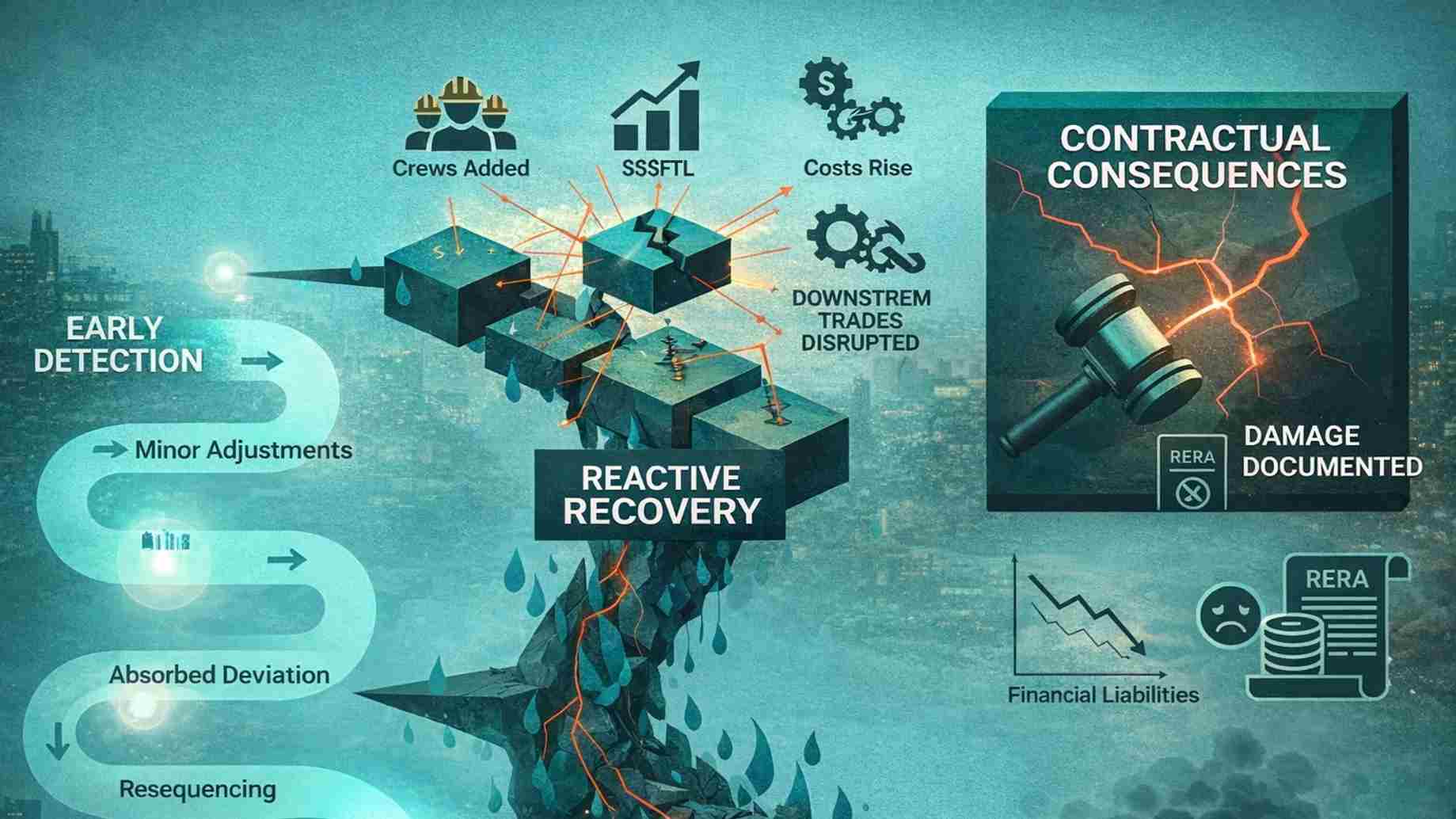
Early deviations can be absorbed through resequencing or minor adjustments. Late deviations force reactive recovery. Crews are added. Costs rise. Quality risks increase. Downstream trades are disrupted.
At a certain point, delay is no longer just operational. It becomes contractual.
For real estate and regulated projects, late completion can trigger penalties, loss of buyer confidence, and statutory consequences. Under frameworks like RERA, missed delivery commitments can translate directly into financial liabilities.
This is why construction project controls must focus on early visibility, not post-facto explanation. Detecting variance late does not prevent damage. It only documents it.
Why traditional tracking methods fall short
Spreadsheets capture intent, not execution. Disconnected tools fragment reality.
The schedule lives in one system. Site updates arrive in messages. Approvals sit in email. Progress is then reconstructed into a report days or weeks later.
By the time leadership sees the data, the site has already moved on.
That is not construction progress tracking. That is a reconstruction of events after the fact.
Accurate tracking requires execution data to flow directly into the timeline, not be interpreted later.
What accurate planned vs actual tracking looks like
Effective tracking shares a few clear characteristics:
- Execution captured at activity and work-package level, not broad summaries
- Direct linkage between site updates and the live schedule
- Automatic roll-ups to WBS and milestone views
- Clear visibility into variance, not just completion
This is where baseline vs actual becomes meaningful. Teams can see how far execution has drifted from commitment and whether recovery is still feasible.
When schedule variance is visible early, management can act selectively instead of reacting broadly.
That is the difference between monitoring activity and controlling delivery.
Turning planned vs actual into a management tool
When accuracy improves, behaviour changes.
Leadership stops asking for explanations and starts making decisions. Teams align faster because reality is visible to everyone. Recovery discussions shift from blame to action.
Catch-up planning becomes deliberate instead of desperate. Decisions about adding resources or money are made with clarity, not guesswork.
This is how construction project controls shift from reactive firefighting to controlled execution. Tracking becomes a management tool, not a reporting obligation, supported by the right construction software.
Analyzing the accuracy gap in planned vs actuals in construction projects
The problem
Projects track timelines and progress, but execution data is delayed and inconsistent. Forecasts rely on weak inputs. Leadership loses confidence in delivery commitments.
The real issue
Construction does not lack reporting.
It lacks accurate, timely execution data.
The solution
Modern teams embed tracking into daily execution:
- Site progress captured as work happens
- Automatic comparison against baseline vs actual and live plans
- Schedule variance visible across activities, WBS, and milestones
- Dashboards that surface risk, not just progress
This is only possible when teams use integrated construction software designed for execution, not documentation.
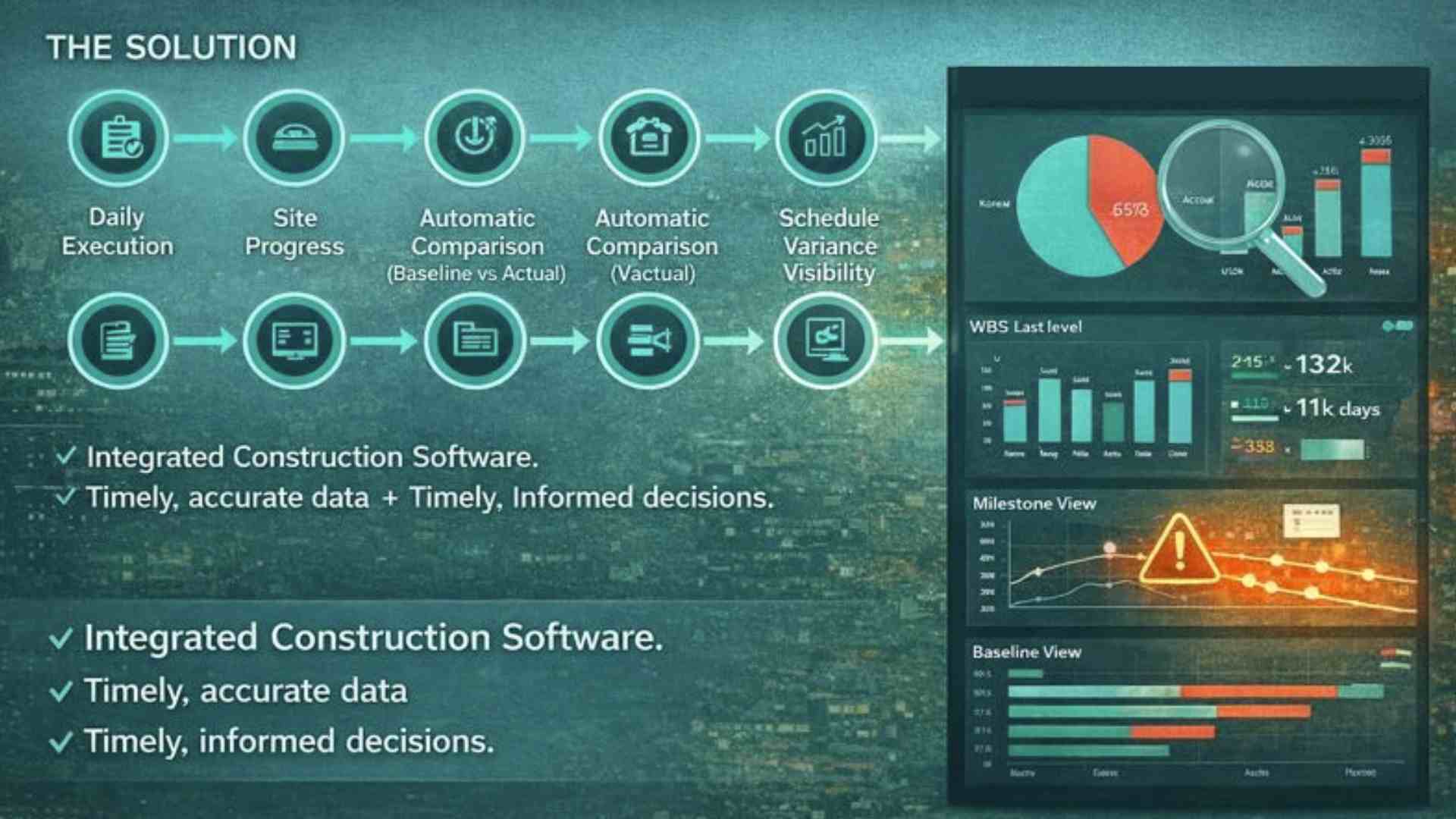
Inncircles construction software connects planning, site execution, and reporting into one system. Progress captured on site directly updates the timeline, improving construction progress tracking and enabling credible forecasting.
The next step
Planning sets direction.
Visibility shows what is happening.
Accuracy determines whether you stay in control.
Projects that finish well are not the ones with the best reports. They are the ones that detect reality early and act decisively.
Ready to move from reporting to control? Book a demo and see how Inncircles helps teams surface risk early, protect commitments, and run stronger construction project controls with reliable project forecasting.