
Executive Summary
Building a new capital city is not just an infrastructure challenge, it is a governance challenge.
The Andhra Pradesh Capital Region Development Authority (APCRDA) is delivering one of India’s largest greenfield capital city development programs, with public buildings, trunk roads, utilities, and Land Pooling Scheme (LPS) assets progressing simultaneously across the capital region. Hundreds of work packages, multiple contractors, and parallel execution fronts created a scale and complexity that could not be managed through traditional reporting mechanisms.
To address this, APCRDA adopted an integrated ICT-based construction management approach, implementing Inncircles Arena in collaboration with Nippon Koei India Pvt. Ltd. and Inncircles Technologies. The objective was clear: establish a single, reliable view of execution that leadership, engineers, and consultants could trust.
The platform brought together contractors, Project Management Consultants (PMCs), the Program Management Consultancy (PGMC – Surbana Jurong), and departmental stakeholders onto a common digital environment. Leading contractors such as L&T, MEIL, NCC, Shapoorji Pallonji, NCC, BSCPL, and others, supported by PMCs including Voyants, Feedback Infra, Tractebel, LEA, TYPSA, TUV India, Colliers, Aarvee, and NKI, began reporting and reviewing progress through standardized digital workflows.
Rather than being deployed as a fixed system, the platform evolved continuously based on feedback from APCRDA departments and the PGMC, ensuring alignment with on-ground realities, governance needs, and decision-making requirements at scale.
Key Digital Execution Capabilities
End-to-End Visibility: Macro to Micro-Level Control
One of the earliest challenges APCRDA faced was fragmentation, i.e., progress data existed, but it was scattered across contractors, consultants, spreadsheets, and presentations.
The digital platform fundamentally changed this. For the first time, leadership could move seamlessly from a portfolio-level view of the capital region to individual packages, locations, and site activities without changing systems or waiting for consolidated reports.
This macro-to-micro visibility allowed execution teams to quickly understand where progress was on track, where it was slipping, and which work fronts required immediate attention. What was previously a retrospective review process became a continuous, real-time understanding of execution across the region.
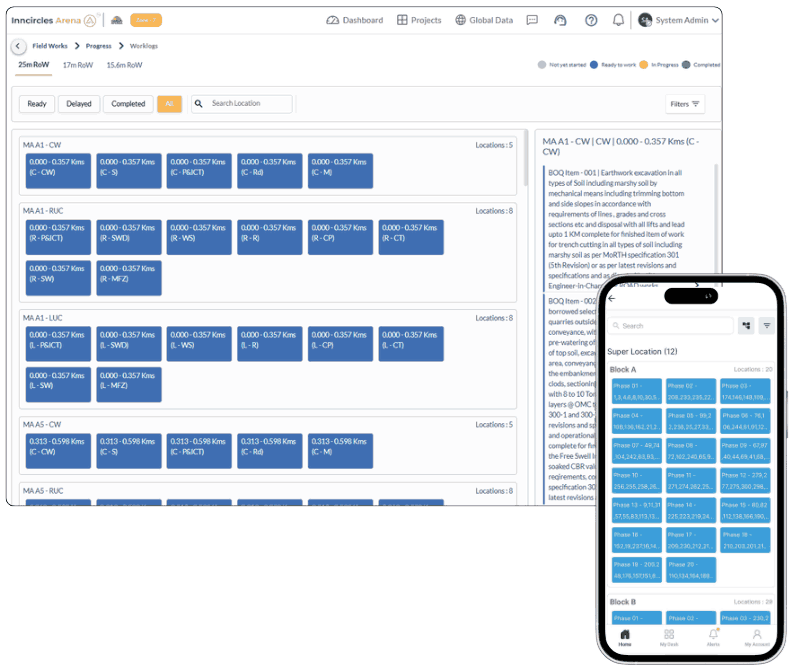
Mobile-First Site Data Capture and Validation
Accurate progress tracking depends on what happens at site every day.
Site teams across projects began using mobile-based workflows to report daily execution. This included raising Requests for Inspection (RFIs), recording daily worklogs with executed quantities mapped directly to BOQs, capturing geo-tagged photographs, and flagging physical obstructions or constraints.
What made this approach effective was not just data capture, but validation. Every submission passed through structured review by PMCs, the PGMC, and departmental engineers. This created a culture of accountability and consistency ensuring that reported progress reflected actual ground conditions, not assumptions or delayed summaries.
Real-Time BIM-Integrated Progress Monitoring
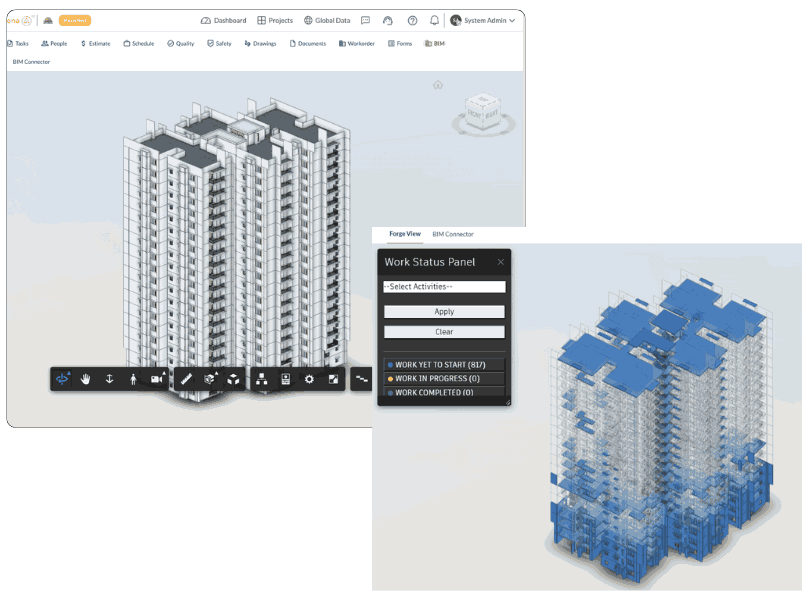
As execution progressed, APCRDA extended monitoring beyond numbers and charts by integrating site progress directly with BIM models.
Construction activities were linked to BIM elements and mapped to Work Breakdown Structures (WBS), enabling stakeholders to visualize progress spatially. Time-based (4D) simulations helped teams understand sequencing, dependencies, and future work fronts, making discussions around delays or acceleration far more concrete.
This shift from document-based tracking to asset-centric visualization significantly improved shared understanding among engineers, consultants, and leadership.
Drone Survey Integration for Ground Validation
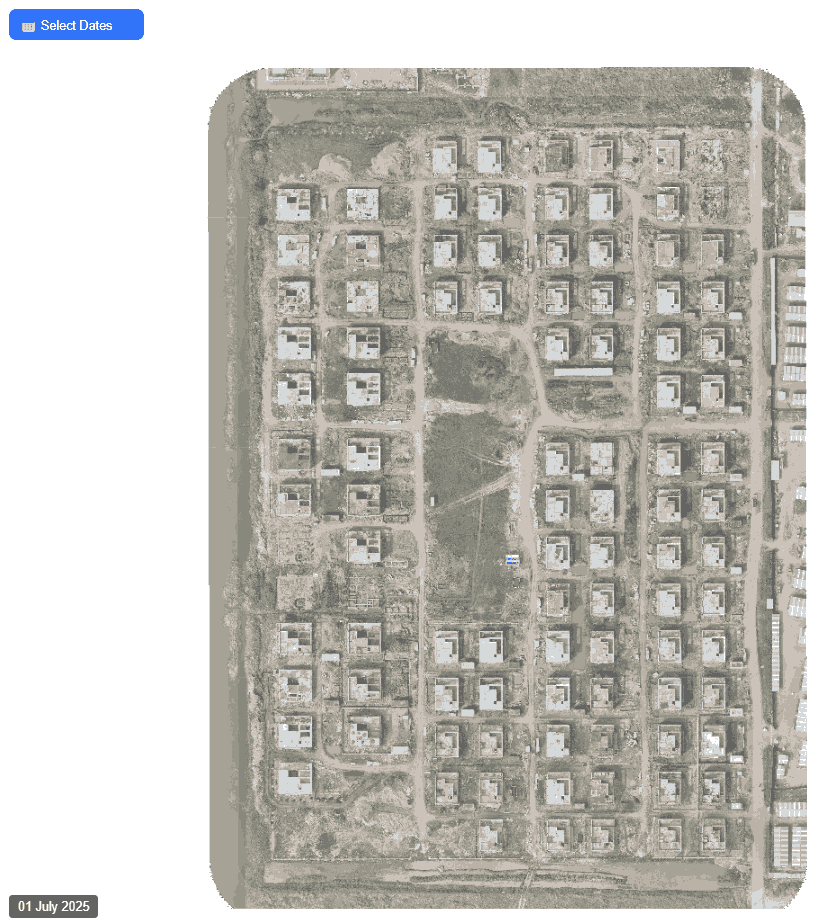
Given the geographic spread of works, particularly for roads, utilities, and linear infrastructure, physical inspections alone were not always sufficient.
Drone surveys were integrated into the platform to provide periodic, independent validation of reported progress. These surveys proved especially effective in verifying large-area execution and identifying discrepancies early.
By combining drone data with site-reported progress, APCRDA strengthened confidence in execution data while reducing the need for frequent manual inspections across dispersed locations.
Real-Time Dashboards for Decision-Making
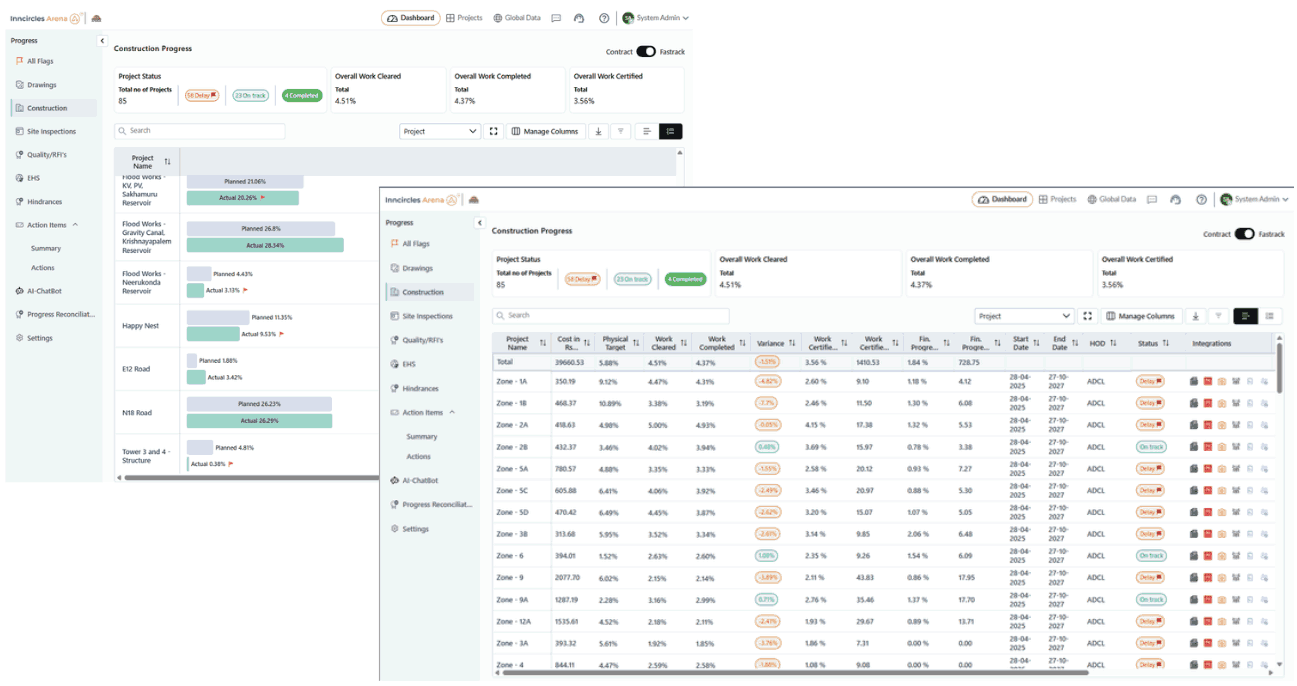
At the leadership level, decision-making depends on clarity.
The platform delivered role-based dashboards that consolidated schedule progress, drawing approvals, inspections, quality observations, safety incidents, and overall project health into a single view. Instead of assembling information from multiple sources, review meetings became more focused, data-driven, and action-oriented.
Risks were identified earlier, corrective actions were tracked systematically, and decision cycles shortened particularly critical in a program where delays in one package could cascade across others.
Outcomes and Impact
The integrated digital execution approach resulted in tangible improvements across the capital city program:
- Greater transparency and accountability across contractors, consultants, and departments
- Earlier identification of delays, risks, and execution bottlenecks
- Consistent and standardized reporting across hundreds of packages
- Faster, evidence-based decision-making at both project and program levels
- Reduced manual reporting effort and duplication
- Stronger coordination between site teams and office stakeholders
- Improved oversight of quality and safety compliance
- Higher confidence in progress reporting through BIM and drone validation
- A scalable digital foundation for future phases and programs
Conclusion
Managing a mega-scale urban development program requires more than engineering capability; it requires digital governance.
Through the adoption of an integrated ICT construction management platform, APCRDA established a unified, data-driven execution framework that brought clarity, accountability, and control to one of India’s most complex infrastructure initiatives.
This experience demonstrates how public agencies can leverage digital platforms not only to monitor construction but to fundamentally transform how large-scale programs are governed, reviewed, and delivered. The approach offers valuable lessons for governments and development institutions undertaking complex, multi-stakeholder infrastructure programs worldwide.